Four Ways to Turn L1 Validator Fees Into AVAX Buy Pressure
Reading Time: 9-12 minutes
Every L1 running on Avalanche pays a continuous fee to keep its validators active. Those fees are denominated in AVAX. And every AVAX spent on validator fees is burned. Gone. Permanently removed from the supply. That makes the fee model one of the most direct levers for AVAX buy pressure that exists in the protocol today.
The question isn’t whether L1 fees should create buy pressure. They already do. The question is whether the current model does it well enough, and whether a smarter design could do it better.
That’s what ACP-255 is really about. Not just repricing validators. Redesigning how Avalanche captures value from its own growth. The more L1s launch, the more validators they need, the more AVAX gets burned. But the shape of that burn depends entirely on the fee curve.
Two objections forced me to think harder about the fee design:
-
ACP-77 (the current model) is not actually a flat fee. It’s dynamic, path-dependent, and only looks flat below the target most of the time. Any replacement has to be compared honestly.
-
If adding validators can ever make an L1 cheaper in aggregate, total AVAX burn goes down as the network grows. That’s the opposite of what you want. More validators impose more work on the network. Total fees should never drop just because an L1 decentralizes.
That second point matters a lot for buy pressure. If the fee model lets L1s game their way into lower total costs by adding validators, you lose burn exactly when the network is growing fastest.
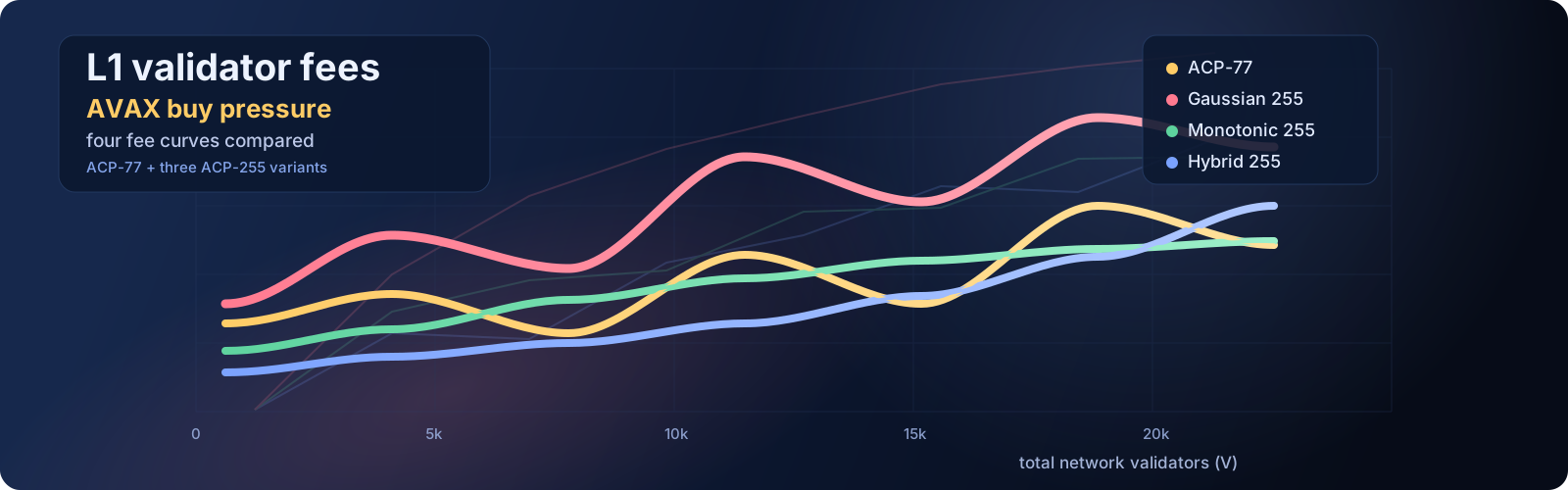
So instead of defending one formula, I mapped four. And I built an interactive explorer so you can see exactly how each one turns validator growth into buy pressure.
Everyone Is Wrong About ACP-77
Before you can talk about improving AVAX burn, you have to understand what the current model actually does. And one mistake I made early on was talking about ACP-77 as if it were basically a flat fee.
It’s not.
ACP-77 uses a dynamic validator fee algorithm. Below the target, it mostly behaves like a minimum fee floor, which means minimal burn. Above the target, it compounds upward depending on how long the network stays above that threshold. That’s when the burn gets serious.
The key variable is T, the target validator count.
Below 10,000 validators, ACP-77 feels almost flat. Burn is low. Above 10,000, it becomes increasingly punitive and burn ramps up fast. But it says almost nothing about the shape of a single L1’s validator set. It prices global network load, not individual L1 structure.
That’s the gap. An L1 running 1 validator and an L1 running 15 pay almost the same per-validator rate. There’s no mechanism to capture more value from centralized setups or reward decentralized ones. That’s where ACP-255 comes in.
The Instinct Is Right. The Shape Betrays It. Gaussian
The first ACP-255 variant adds two ideas designed to maximize burn during the network’s most important growth phase: an L1-size multiplier that taxes centralized setups harder, and a Gaussian network factor that peaks around 10,000 validators.
Show the full multiplier and network factor math
The multiplier punishes small validator sets exponentially:
\[\text{multiplier}(n) = 1 + 17.84 \cdot e^{-0.3 \cdot (n - 1)}\]At n = 1, the multiplier is roughly 18.84x. By n = 10, it’s dropped to about 1.84x. The curve flattens quickly. The penalty is almost entirely about discouraging single-digit validator counts.
The network factor creates a growth-phase burn curve:
\[\text{networkFactor}(V) = 1 + 2.84 \cdot e^{-\left(\frac{V - 10000}{7500}\right)^2}\]This peaks near V = 10,000 and tapers off in both directions. During the most important growth phase, the network captures more fee revenue.
The intuition behind this is good for buy pressure. Small validator sets get taxed hard, which means higher burn per L1. The network gets a growth-phase burn curve that peaks exactly when Avalanche is scaling fastest. The 10 to 15 validator zone becomes economically attractive relative to 1 to 3 validator setups, pushing L1s toward decentralization.
But the current Gaussian version has a real weakness.
The aggregate-fee problem: Depending on how per-validator fees interact with total validator count, an L1 adding validators can actually see its total fee burden fall. That means less AVAX burned as the network grows. That’s backwards. More validators should mean higher total fees and more burn, because more validators impose more cost on the network. The current curve fails this test in places.
Even though this version is the most faithful to the original ACP-255 instinct, it’s not the easiest one to defend.
Easier to Defend Than to Love Monotonic
The pure monotonic replacement does one thing very clearly:
Total L1 fees always increase as an L1 adds validators.
That lets you preserve a resource-pricing safety property while still making larger validator sets more efficient on a per-validator basis.
One validator is expensive, which means high burn per L1. Ten validators cost more in total, which means even more burn. But the average cost per validator drops, so decentralization still gets rewarded. The key property: total AVAX burned always increases as the network grows. No loopholes.
If all I cared about was guaranteeing that burn never decreases, this is the version I’d choose.
But governance isn’t only about clean guarantees. It’s about capturing the most value during the growth phase, when buy pressure matters most.
The Compromise That Feels Like a Phase Change Hybrid
The hybrid model maximizes burn during the growth phase, then switches to strict resource pricing once the network is large enough. Best of both worlds for AVAX buy pressure.
Why do I like this more than the pure monotonic version?
Because the growth phase is when buy pressure matters most. That’s when new L1s are launching, when AVAX demand is building, when the burn should be aggressive. The Gaussian model captures that energy. But once the network matures past 11k validators, you need a model that’s airtight on resource pricing. No loopholes, no aggregate-fee problems.
The hybrid gives you both: aggressive burn early, clean economics later.
You've seen the argument. Now break it.
Drag the sliders on the left to change the network size (V), how many validators your L1 runs (n), and how long ACP-77 has been above target.
Watch the curves update in real time. The left chart shows what happens when one L1 decentralizes. The right chart shows what happens as the whole network matures.
Compare the four numbers in the sidebar. Those are the monthly fees each model would charge your L1 under the exact conditions you just set.
The Playground
Four models. Two charts. Three knobs. Go.
If one L1 decentralizes, what happens to total cost?
Hold total network size fixed, then vary the L1 validator count.
If Avalanche matures, what happens to one fixed L1?
Hold one L1 fixed, then vary the total network validator count.
ACP-77
Mostly about global network pressure, not L1 structure.
Gaussian
Best expression of the original thesis, but hardest to defend on aggregate-fee grounds.
Monotonic
Much easier to defend because total fees always rise with validator count.
Hybrid
Preserves the growth-phase story, then becomes stricter when the network gets large.
What the Charts Show More Clearly Than Words
A few things jump out once you move the sliders around, especially if you think about them in terms of AVAX buy pressure.
ACP-77 burns almost nothing below 10k validators. It only gets interesting once the network is already large and stays above target for a while. For buy pressure during the growth phase, it’s basically invisible.
Gaussian is the most aggressive on burn during the growth phase. It taxes centralized L1s hard, peaks around 10k validators, and captures the most value from early network expansion. But it has a hole: total burn can actually decrease when L1s add validators. That undermines the whole thesis.
Monotonic guarantees burn always increases. No exceptions, no loopholes. But it doesn’t have a growth-phase boost. The burn is steady, predictable, and less aggressive where it matters most.
Hybrid gives you growth-phase aggression from the Gaussian plus the monotonic guarantee once the network matures. Early burn is maximized. Late burn is airtight. The transition happens around 10k validators, exactly where the network starts caring more about long-term sustainability.
If I had to pick one model for maximizing AVAX buy pressure today, it would be the hybrid. Not because it’s perfect. The transition band can be tuned, the post-threshold curve can still be argued over, and ACP-77 comparisons should be treated carefully because it’s path-dependent, not a simple static fee. But it captures the most value during the growth phase while guaranteeing that burn never decreases as the network scales.
Why I Wrote It This Way
I didn’t want this post to be another governance thread where the formulas are hidden in paragraphs and everyone argues off memory.
When a proposal lives or dies by curve shape, and the curve shape determines how much AVAX gets burned, you should be able to see the curves.
So that’s what this is. Not a final ACP. Not a vote solicitation. Just the most honest version of the work at this stage: here are four fee models, here is how each one turns validator growth into AVAX buy pressure, and here is the one that currently works best.
If you want to discuss ACP-255 seriously, start with the PR. Then come back here and break the charts.


Giacomo Barbieri
Independent builder and operator across crypto, AI, and native apps. Former Head of Growth at Routescan.